
Gilbertson Investigations Inc. is a police-practices expert-witness practice retained by counsel across the country. The work was decades deep. The website was not presenting any of it. We rebuilt the whole thing - and the client was back online inside two days.

There was exactly one thing the client wanted carried over from the old site: his lion. Everything else was open.
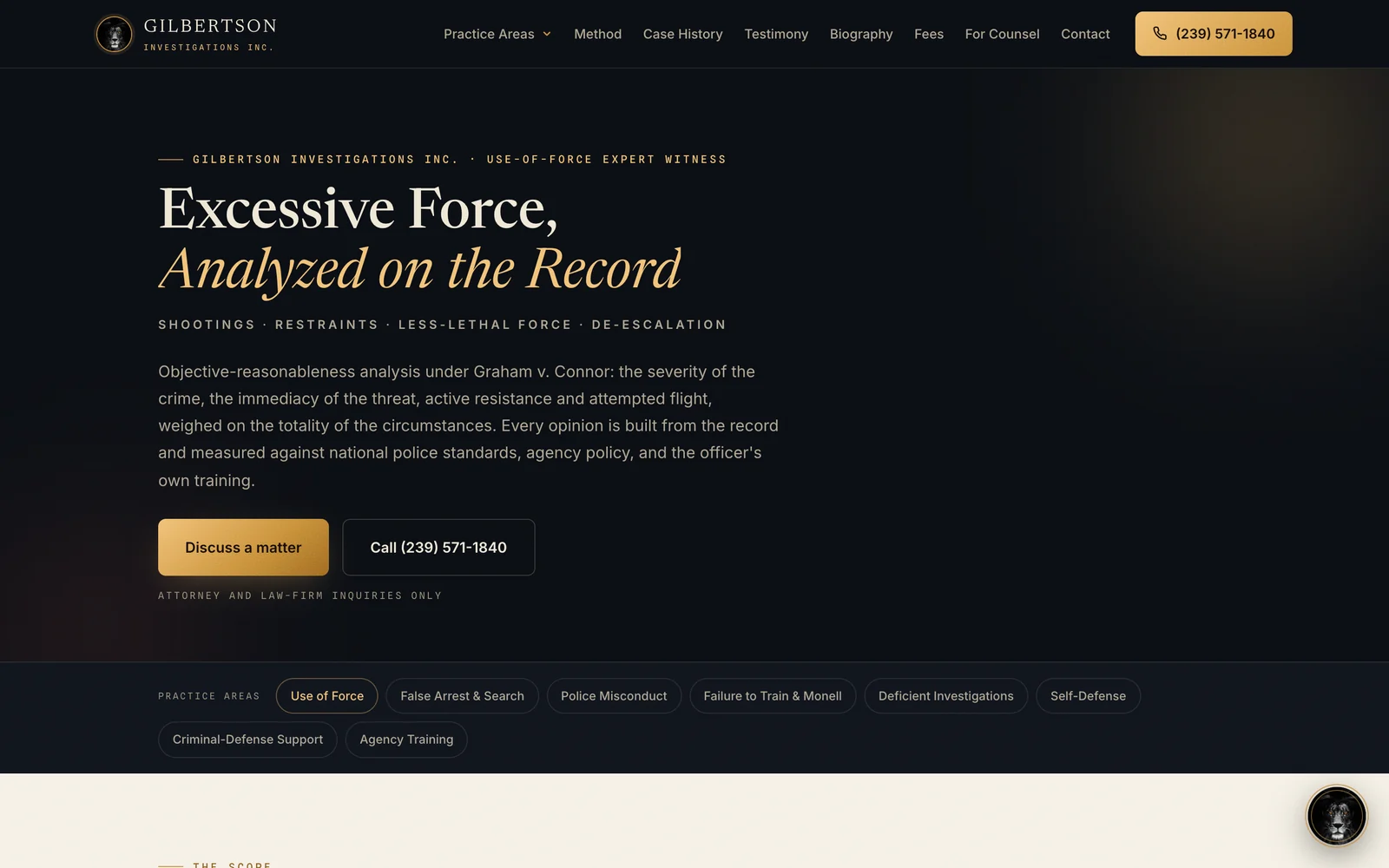
So the lion became the fixed point. The rest of the identity was built around it in ink, parchment and brass, and the pages were typeset the way the practice actually works - like a case file rather than a brochure. The headline names the two things counsel searches for, and the page states who the practice is for in its first line.
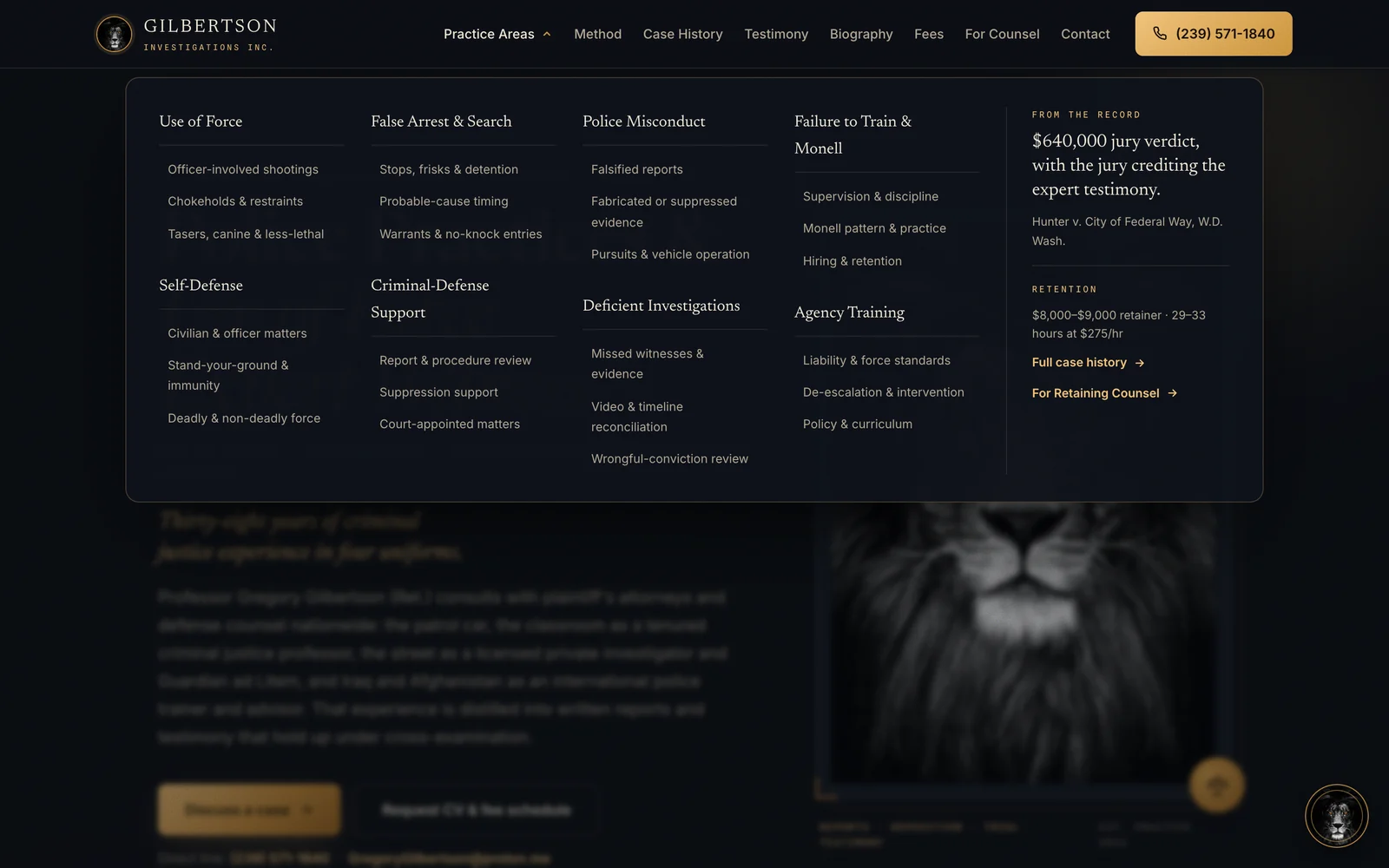
Most trade sites bury their range in one flat services page. Here the range is the offering, so it got the architecture it deserved: eight practice-area pillars, each with its own sub-topics underneath.
The mega menu isn't a list of anchors pointing back at the homepage. Every item behind it is a standalone page with its own scope, its own analysis, and its own way in.
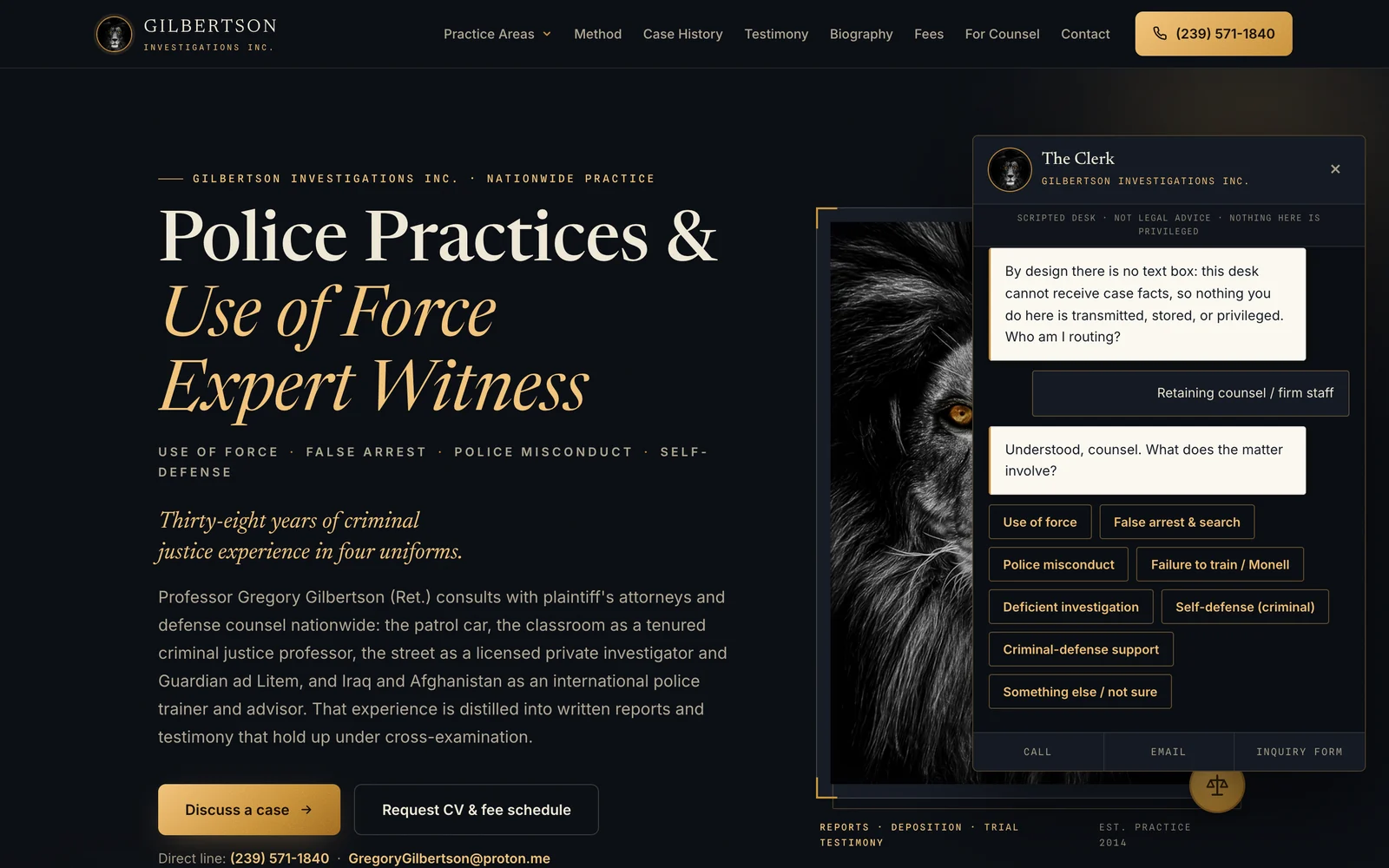
This site's concierge uses scripted choices rather than a text box.
A free-text chat window on an expert-witness site is an invitation for retaining counsel to type privileged case facts into a third-party widget. So we removed the ability entirely: The Clerk is chips only. It cannot receive what it must never hold, it transmits nothing, and it says so in its own header.
It still does the work - it routes counsel, agencies and individuals down different paths, and hands the answer into that page's own form with the fields already filled.
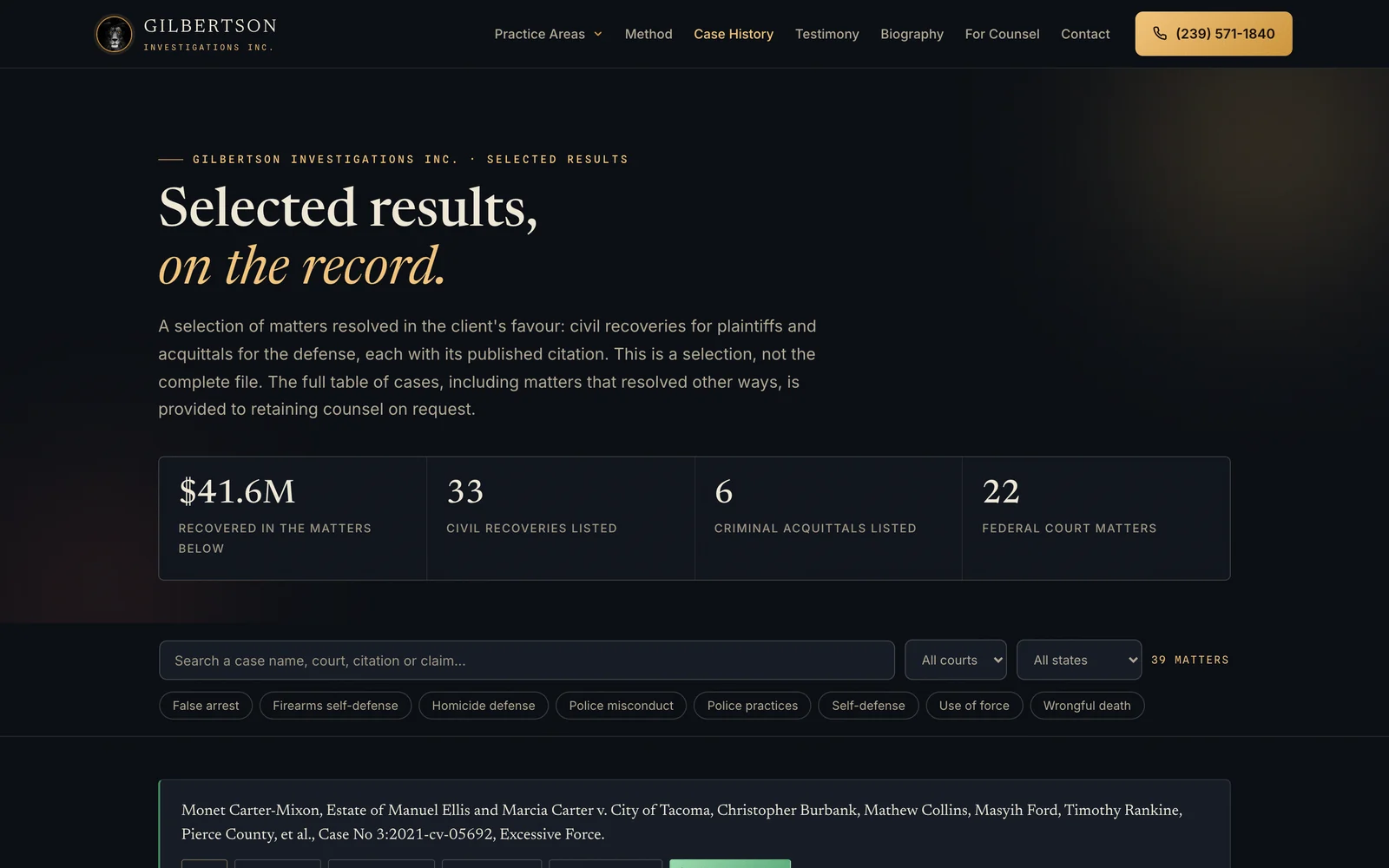
The client's case list existed as a table in a document. We turned it into a page counsel can actually use: search it, or filter by court, by state, by topic, and watch the count narrow live.
Two decisions mattered more than the interface. Citations render verbatim - a legal citation is never paraphrased or reformatted. And the page is framed honestly as a selection rather than a complete record, because a filtered list presented as the whole file is precisely what opposing counsel would go after.
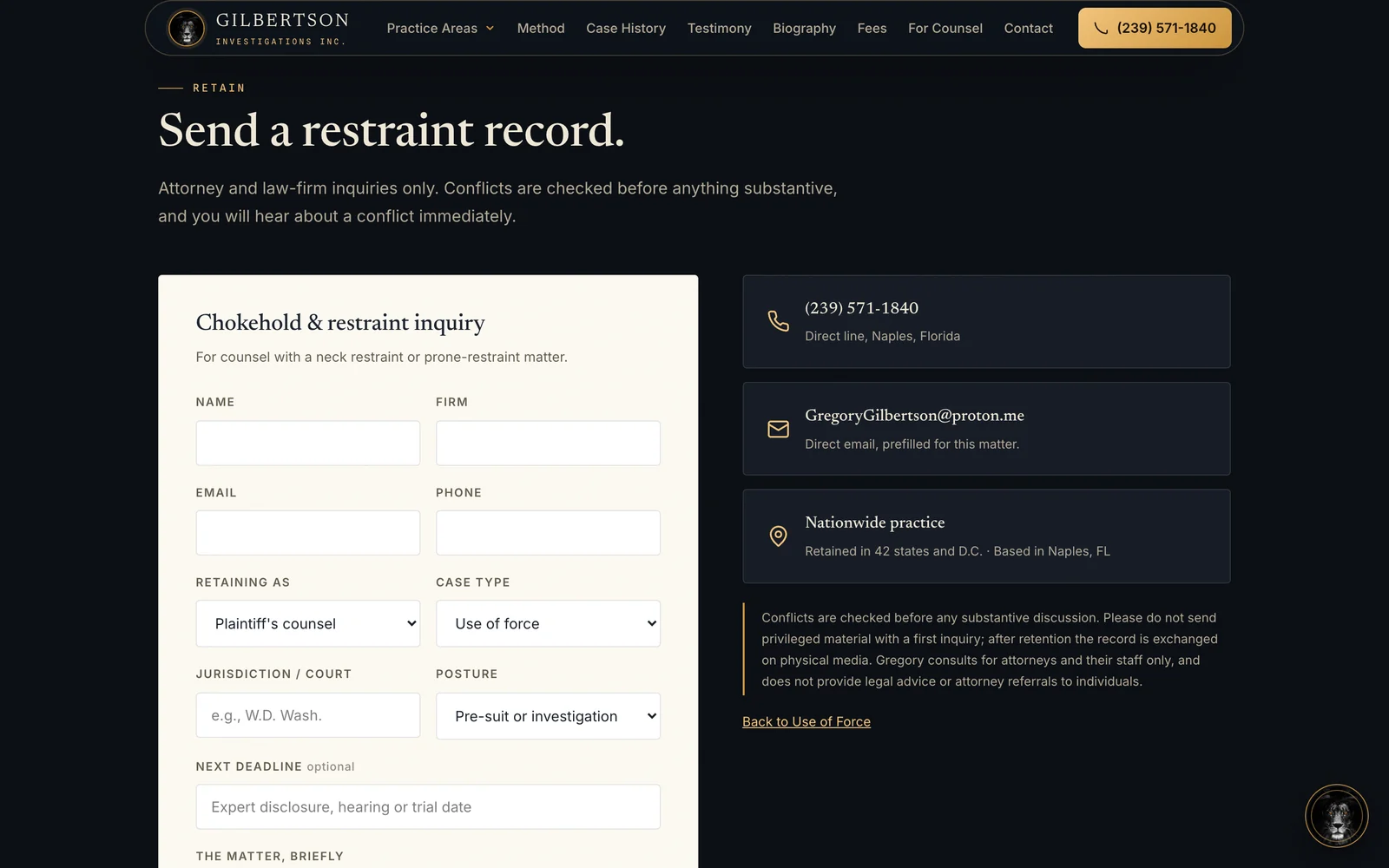
A single shared contact form tells you nothing about why someone called. Every page here carries its own form instead, with the case type already set to the topic of the page it sits on.
Each one submits a distinct subject line, so the inbox names the exact page that produced the lead before the message is even opened. Counsel forms and agency-training forms are genuinely different instruments, not one form with a swapped label.
A rebuild is where hard-won search equity quietly dies. Six of the new pillars deliberately reuse the old site's indexed URLs, so those addresses resolve as live pages rather than redirects.
Everything else from the previous structure is mapped, including the whole legacy topic prefix. Old links keep working, and the branded 404 that catches the rest returns an actual 404 - not a soft 200 quietly inviting search engines to index infinite copies of the homepage.
“I was immediately impressed with Brandon’s remarkable grasp of my needs, concerns, and diverse career. Within 36 hours I was back up and running like never before with a remarkably informative and stylishly designed website that has surpassed all of my expectations.”
The client describes the initial turnaround in the quote above. Subsequent work expanded the reference library, selected-results pages and inquiry routing described below.
Daubert and Graham v. Connor explainers, report anatomy, retention mechanics, lexicons by discipline - every article written for the retaining attorney, each with author and date markup.
A searchable selected-results page built from the client’s own color-coded case table, plus dedicated Washington and Florida jurisdiction files, a Team page, standalone profiles for the practice’s two consultants, and posted privacy, terms and accessibility pages.
A tightly-scoped Google Ads search campaign: six ad groups, every keyword exact-matched to its own landing page, verified ad copy grounded in the site, and a negative list that keeps job-seekers and DIY searches out.
Visible practice-area answers, a full-site text reference, named crawler access and a Bing Webmaster connection for discovery checks. These are implementation details, not proof of AI recommendations.
Served from the edge with the apex and www bound to the same worker, HTTP forced to HTTPS in code rather than depending on a dashboard toggle.
Person, ProfessionalService, Service, FAQPage and BreadcrumbList markup, so the practice is machine-readable at every level of the hierarchy.
An llms.txt index and full-site text reference accompany readable practice pages and named crawler access. Search engines decide what to retrieve and cite; this write-up does not measure citations.
Six old slugs restored as live pages, the remaining legacy structure mapped, and the full topic prefix redirected per-topic.
One form handler, a context for every page. Hidden fields carry the page, practice area and matter type into the notification email.
HSTS, nosniff, referrer-policy, permissions-policy and frame-options on every response, with the client's existing analytics property carried over intact.
Every site we ship gets the same treatment: real architecture, honest copy, and a conversion path on every page. Tell us what you do and we’ll show you what it could look like.